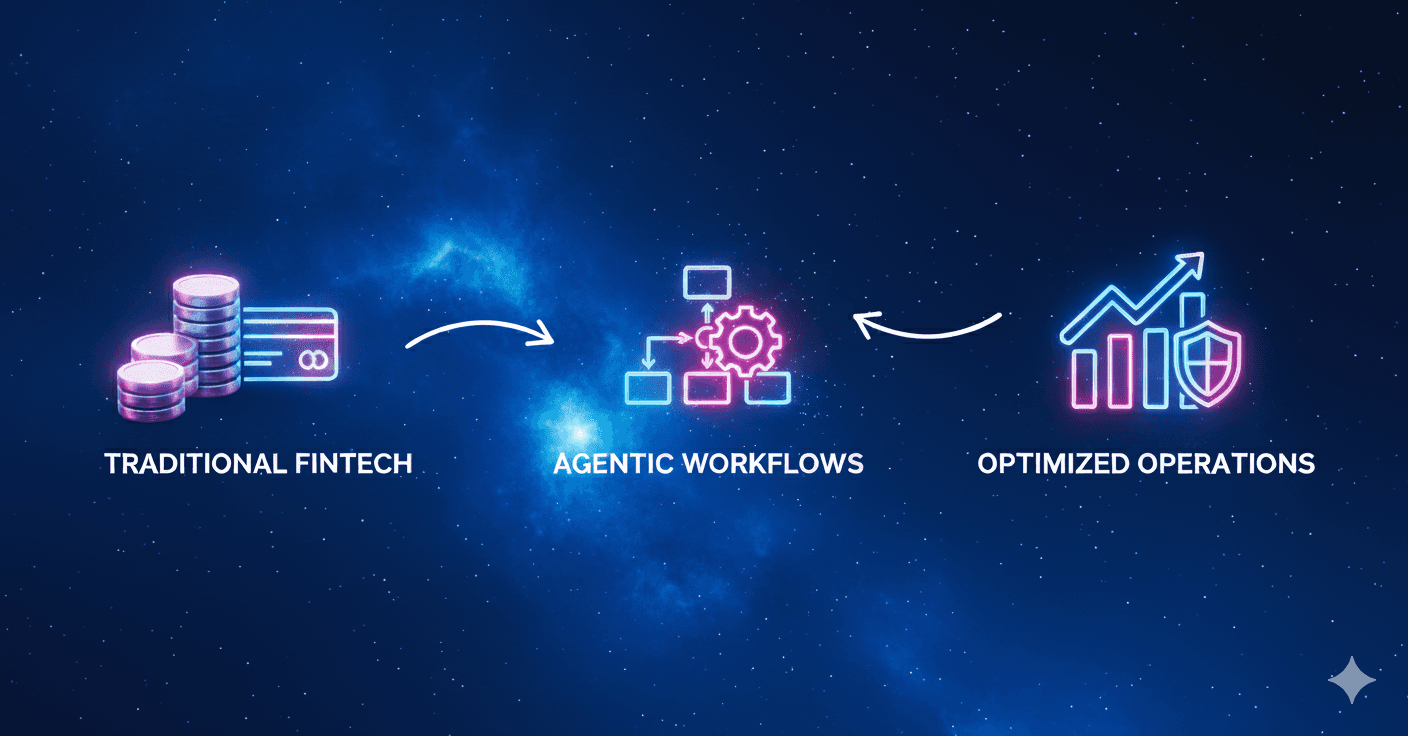
Discover how agentic AI workflows are transforming fintech operations from autonomous decision-making to real-time risk management.

Parul Chouhan
Chief of Staff
Table of Contents
Introduction: Why Fintech Operations Are at an Inflection Point
What Are Agentic Workflows?
Why Fintech Is Ripe for Agentic AI
Real-World Use Cases of AI Agents in Fintech
ROI Framework: Measuring the Impact of Agentic Workflows
Challenges & Compliance Considerations
The Road Ahead: Building a Fintech Powered by AI Agents
Final Takeaway + Call to Action
Introduction: Why Fintech Operations Are at an Inflection Point
Fintech has started reaching its so called “automation maturity curve.” The industry that once disrupted banking with mobile apps and instant KYC is now struggling in manual workflows — loan verifications, collections, onboarding, reconciliations, and support queues that consume both manpower and margins. And affecting User Experiences and journeys.
But in 2025, a new layer of automation is emerging, Agentic AI systems that don’t just execute tasks, but decide how to execute them. These AI agents in fintech are quietly building what can only be described as “self-thinking workflows.”
And the question isn’t if — it’s how fast fintechs can adapt.
So, What Are Agentic Workflows?
Traditional automation follows scripts. Agentic workflows follow goals.
In simple terms, agentic workflows are systems where AI agents act autonomously, understanding intent, collaborating with other systems, and optimizing outcomes in real time.
For instance:
A lending agent that analyzes borrower history, credit scores, and repayment behavior — then suggests personalized restructuring plans.
A collections agent that dynamically changes its communication tone based on previous responses.
A compliance agent that flags anomalies and prepares pre-audit summaries without human input.
Unlike static bots, agentic systems use contextual reasoning, memory, and continuous learning to handle complex fintech operations with precision.
Why Fintech Is Ripe for Agentic AI
Fintech sits at the intersection of data intensity, process repetition and infrastructure — the perfect playground for agentic AI.
Operational Challenge | How Agentic AI Solves It |
|---|---|
Manual reconciliation of transactions | Agents automate cross-ledger verification |
Slow loan origination and KYC checks | Agents streamline verification using decision trees following strict SOPs |
High cost of customer support | Voice AI agents resolve tier-1 queries autonomously |
Delayed collections | AI agents predict default risk and trigger proactive outreach |
Compliance burden | Agents auto-generate reports aligned with regulatory standards |
The result? Lower OPEX, faster TAT, and an organization that moves from rule-based to reason-based decisioning.
Real-World Use Cases of AI Agents in Fintech
Let’s break down how AI agents are reshaping fintech operations today:
1. Collections Optimization
Voice agents personalize payment reminders, handle objections, and escalate only complex cases to human teams.
Outcome: Up to 35% improvement in recovery efficiency.
2. Underwriting & Risk Modeling
Agents analyze historical borrower data, sentiment, and credit movement across bureaus.
Outcome: Reduced NPAs, faster loan approval cycles.
3. Customer Onboarding
AI agents guide users through digital KYC, verifying docs and updating CRMs automatically.
Outcome: 2× faster onboarding, fewer drop-offs.
4. Fraud & Compliance Automation
Agents cross-validate transactions and detect anomalies in near real-time.
Outcome: Compliance costs down by 20–25%.
5. Treasury & Liquidity Management
AI agents monitor cash flow patterns and trigger alerts when balances fall below defined thresholds.
Outcome: Smarter liquidity decisions and risk mitigation.
ROI Framework: Measuring the Impact of Agentic Workflows
ROI Metric | Traditional Systems | Agentic AI Workflows |
|---|---|---|
Average handling time | 8–10 mins per task | 2–3 mins (autonomous handling) |
FTE dependency | 1:1 task ratio | 1 agent handles 5–10 workflows |
Error rate | 4–6% | <1% with feedback loops |
Cost savings | 0% baseline | 30–40% YoY savings |
Compliance reporting | Manual & delayed | Instant auto-generated summaries |
In a fintech world defined by thin margins and regulatory scrutiny, every saved minute converts into margin expansion. Agentic systems don’t just optimize, they compound operational leverage.
Challenges & Compliance Considerations
Of course, no technology comes without guardrails.
Data Governance: AI agents require secure access to sensitive financial data.
Auditability: Agentic workflows must maintain explainable decision trails.
Regulatory Alignment: RBI and SEBI frameworks around AI ethics will demand transparency.
Human Oversight: Agentic doesn’t mean human-free, it means human-directed and optimised intelligence.
Enterprises building these systems must architect for traceability + compliance-first design.
The Road Ahead: Building a Fintech Powered by AI Agents
The next decade in fintech will be defined by autonomous operations. Agentic AI will move beyond voice or text — toward a network of interoperable agents that manage everything from collections to compliance in real time.
Those who build early will own the operational IP layer of the future fintech stack.
Final Takeaway
Agentic AI isn’t replacing humans — it’s redefining what humans can do. The fintechs that embed agentic systems today will outperform peers in speed, cost efficiency, and compliance readiness.
See how Intelekt AI helps fintechs deploy agentic workflows that cut OPEX by 40% and scale intelligently. Book a Demo
Related Posts